How to Get Followers on Pinterest Who Want Your Content
Give people a clear reason to follow your Pinterest profile or boards, then measure follows separately from saves, reach, and website clicks.
Topic: Pinterest guides
To get relevant followers on Pinterest, make it obvious what someone will receive by following you: a recognizable subject, useful public boards, and original Pins that continue that promise. Start by improving your profile and one focused content series, then measure actual follows.
A save is not a follow, and a follow is not a website visit. This guide focuses on the decision to follow your account or a board. If website visits are your priority, use our Pinterest traffic guide instead.
Understand what Pinterest counts as a follower
Pinterest's following and followers guide says a person can follow you or your boards. Someone following several of your boards counts as one follower, not several. To see the people who follow you, open your profile and select Followers beneath your name; in the app, start from your profile photo.
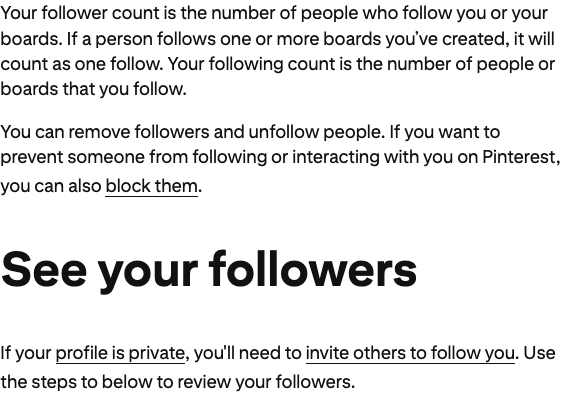
Screenshot of the official Pinterest Help Center, captured October 12, 2026. It explains the count; it does not show a tested growth result.
Private profiles use an invitation-based following process. Do not expect the same public discovery path from a private account. Review visibility settings before trying to grow a public audience, while keeping personal project boards private when appropriate.
Make your profile's promise specific
A visitor should be able to answer three questions quickly: what do you publish, who is it useful for, and why would they want more?
Compare these teaching examples:
| Profile element | Hard to interpret | Clear reason to follow |
|---|---|---|
| Bio | “I love creativity and beautiful things” | “Small-apartment storage ideas, renter-friendly projects, and compact-room layouts” |
| Public board | “Favorites” | “Renter-friendly kitchen storage” |
| Pin series | Unrelated products and quotes | Several original solutions to small-kitchen storage problems |
Use a recognizable name and image, and describe the subject naturally. Avoid a bio made only of repeated keywords. The clearer version helps a person decide; it is not a guaranteed algorithm advantage.
Keep public boards coherent. If a board's title promises kitchen storage but the visible Pins mostly show unrelated travel photos, the visitor cannot judge what following it will bring. Move unrelated saved ideas into another suitable collection.
Give one useful idea a clear continuation
A single Pin can solve a task; a focused series can show that there is more relevant work to come. For example, an original compact-kitchen series could cover:
- Measuring usable shelf space before buying organizers.
- Choosing removable hooks for a rental.
- Comparing drawer dividers for utensils.
- Showing a layout for a narrow cupboard.
Each Pin should be useful by itself. Do not hide an essential instruction simply to force a follow. Use your own work or properly licensed material, with accurate descriptions of what is demonstrated.
A modest invitation such as “Follow for more renter-friendly storage ideas” makes sense at the end of a relevant description. It works best when the profile already contains related examples. Repeating that line on unrelated content gives the visitor little reason to believe the promise.
Choose a publishing pace you can sustain
Plan a small set of related ideas and review each before publication. Decide on a schedule that fits the time you need for accurate writing, images, and community responses. You do not need to claim that a particular daily Pin quota unlocks growth.
When a topic earns genuine interest, develop the next useful question within it. Create a new demonstration, comparison, or explanation rather than uploading near-identical images to many unrelated boards.
Pinterest's Community guidelines prohibit spam and artificial manipulation. Bought followers, coordinated engagement exchanges, and unsolicited promotional messages do not tell you whether people want your content. Respond helpfully to relevant comments without turning every exchange into a sales pitch.
Measure follows alongside the actions that precede them
For a business account, open a Pin you created and inspect its stats. Pinterest documents the route through your profile's Created area and the expanded statistics in its Pin stats guide. Use a consistent date range and record the Follows metric where available, as well as the profile's total follower count.
| Observation | What it establishes | What to try next |
|---|---|---|
| Saves increase but follows do not | People are keeping particular ideas | Check whether the profile offers a clear continuation of those ideas |
| One topic earns follows; others do not | That topic may fit your audience better | Produce a related useful example and compare again |
| Total follower count barely changes despite new follows | New follows and departures may offset each other | Review the same period, rather than counting only new activity |
| Follows increase but website clicks stay flat | Audience growth and traffic are different outcomes | Use a relevant destination and inspect outbound clicks separately |
These are diagnostic hypotheses, not proofs of Pinterest's ranking formula. A Pin can be saved for later without its viewer wanting to follow the creator. Several changes made at once also make it difficult to tell which change helped.
Run a small, interpretable experiment
Choose one audience promise and one related public board. Record the current follower count and the date. Publish a manageable series over several weeks, with accurate titles and a relevant follow invitation. At the end, compare Pin-level follows and the total count across the same period.
Keep the period long enough to avoid reacting to a single quiet day, but do not call a small sample conclusive. If a series attracts saves without follows, revise the profile promise or make the next series more coherent before increasing volume.
For a blog-based series, Redol's Blog to Pinterest tool can draft titles, descriptions, and image prompts from your article. Check that each draft provides a distinct, accurate idea. Content preparation helps you maintain a series; it cannot promise an audience.
Limits and next steps
The account-count and reporting details were checked against Pinterest's official documentation on October 12, 2026. The profile examples and experiment are editorial recommendations, not a claim of hands-on growth testing. Reach, saves, follows, and revenue remain separate outcomes; there is no promised follower target or completion date.
Browse the Pinterest guides for board management and other everyday tasks.
Related posts
About the Author

Zhang Guo
AI Product Manager · Digital Marketing Consultant
AI product manager and digital marketing consultant with a background in music. I see creativity as the bridge between rhythm and logic, where musical intuition and mathematical precision can coexist in every meaningful product decision.
Follow on X